The Pre-Family History: Here’s the clearest, evidence‑based timeline for when England first became populated, based on the best archaeological findings.
England has been inhabited for more than 800,000 years. The oldest known evidence comes from Happisburgh, Norfolk, where stone tools and ancient human footprints were discovered.
|
Period |
Evidence |
Approx. Date |
|
Earliest human activity |
Stone tools & footprints at Happisburgh |
>800,000 years ago |
|
Early modern humans (Homo sapiens) |
Jawbone from Kents Cavern, Devon |
41,000–44,000 years ago |
|
Continuous habitation begins |
Creswellian culture after last Ice Age |
~13,000 years ago |
During the Ice Ages, Britain was often too cold for long-term settlement. Humans came and went depending on climate conditions. After the last glacial period ended, people returned and remained continuously.
Once the climate stabilized, population grew through:
• Mesolithic hunter-gatherers
• Neolithic farmers (builders of Stonehenge and Avebury)
• Bronze Age and Iron Age cultures, including the Celtic Britons
• 43 AD – Roman conquest; population around 4 million in Roman Britain.
• 5th century – Romans leave; population declines.
• Anglo‑Saxon settlement begins soon after, shaping early English identity.
England began to be populated over 800,000 years ago, with continuous habitation from about 13,000 years ago after the last Ice Age.
how do these groups connect with the Normans
Here’s the clean, evidence‑based way to understand how England’s earlier population groups connect to the Normans. The short version: the Normans did not replace earlier peoples — they layered themselves on top of a very old population structure and became one more strand in a long genetic and cultural braid.
England’s population before 1066 was shaped by several major groups:
• The first continuous settlers after the Ice Age.
• Hunter‑gatherers, then early farmers.
• These groups form the oldest layer of ancestry in Britain.
• Arrived gradually from continental Europe.
• These are the “Ancient Britons” Julius Caesar encountered.
• Migrants from modern Germany, Denmark, and the Netherlands.
• They mixed with the existing Britons and formed the early English kingdoms.
• Mainly Danes and Norwegians.
• Settled heavily in the Danelaw (northern & eastern England).
By 1000 AD, England was a mixed Anglo‑Saxon + Viking + residual Celtic population.
The Normans were originally Scandinavian Vikings who settled in northern France (Normandy) in the 9th–10th centuries.
• They intermarried with local Franks and Gallo‑Romans, adopted French language and culture, and became a new ethnic group.
By 1066, they were French‑speaking Christian nobles with Viking ancestry.
Here’s the key: The Normans were genetically and culturally related to earlier groups in England — but indirectly.
• Vikings settled England (Danelaw).
• Normans descended from Vikings who settled France.
• So both groups share Norse ancestry, but from different migration waves.
• Normans mixed with the local French population.
• This added a Romance-language, continental European component not present in Anglo‑Saxons or earlier Britons.
After 1066:
• Normans became the new ruling elite.
• Anglo‑Saxon and Viking populations remained the majority.
• Over 300–400 years, the groups blended through intermarriage, language shift, and shared institutions.
This is where the genealogical work becomes especially relevant:
• Norman nobles married into Anglo‑Saxon, Welsh, and later Irish aristocratic families.
• Many medieval lineages (Venables, Davenport, Draycott, Colclough, etc.) eventually intersect with Norman-descended families through marriage alliances.
Modern genetic studies show:
• Britain’s population remained largely continuous from the Neolithic onward.
• Anglo‑Saxon migration added a significant but not overwhelming layer.
• Viking and Norman contributions were smaller but culturally powerful.
The Normans influenced language, law, architecture, and aristocratic bloodlines far more than the everyday genetic makeup of the population.
If you’re tracing medieval English lineages:
• Norman ancestry usually enters through landed families after 1066.
• Anglo‑Saxon ancestry comes through pre‑Conquest thegnly families.
• Celtic ancestry appears in border families (Welsh Marches, Cornwall) and later in Ireland.
• Viking ancestry can appear through both Danelaw families and Norman lines.
Normans often serve as the bridge connecting continental medieval nobility to English lineages.
How specific Norman families connect to the Nolan lines.
Absolutely — and this is where the Nolan line becomes genuinely fascinating. The Norman connection doesn’t come through the Irish Nolans (Ó Nualláin) originally, but through the English and Welsh families who married into the Nolan line after the family moved into Ireland, especially during the late medieval period.
Let me lay out the structure clearly so you can see exactly where the Norman blood enters the picture.
This Nolan ancestry ultimately blends two different streams:
• Ancient Gaelic family from Carlow/Wexford.
• Descended from the Laigin (Leinster) kings.
• This line is pre‑Norman and Celtic.
This is where the Norman connection enters — through intermarriage, not origin.
The genealogical work from Nolan-Crombie.com already shows this pattern: the Nolan line intersects with English families who themselves descend from Norman knights, Marcher lords, and gentry.
Based on the branches researched in Nolan-crombie.com — Venables, Davenport, Draycott, Colclough,etc. — the Norman connection comes through these specific families:
• A documented Norman family from Venables, Normandy.
• Arrived with the Normans in the 11th century.
• Lords of Kinderton in Cheshire.
• The research shows the Venables line connects into the Davenport and Draycott networks — which later intersect with the Colcloughs.
• A Cheshire family with Norman‑era origins.
• They intermarried with Venables, Brereton, and other Norman-descended families.
• The Davenports connect into the Draycott line.
• Medieval Staffordshire gentry.
• They intermarried with Norman-descended families in the region.
• The Draycotts connect directly to the Colcloughs.
• A key bridge family.
• Anglo‑Norman in origin, established in Staffordshire.
• Moved to Ireland in the 16th century.
• Married into Irish families — including the Nolans.
This is the critical junction where Norman blood enters the Nolan line.
Here’s the simplified flow:
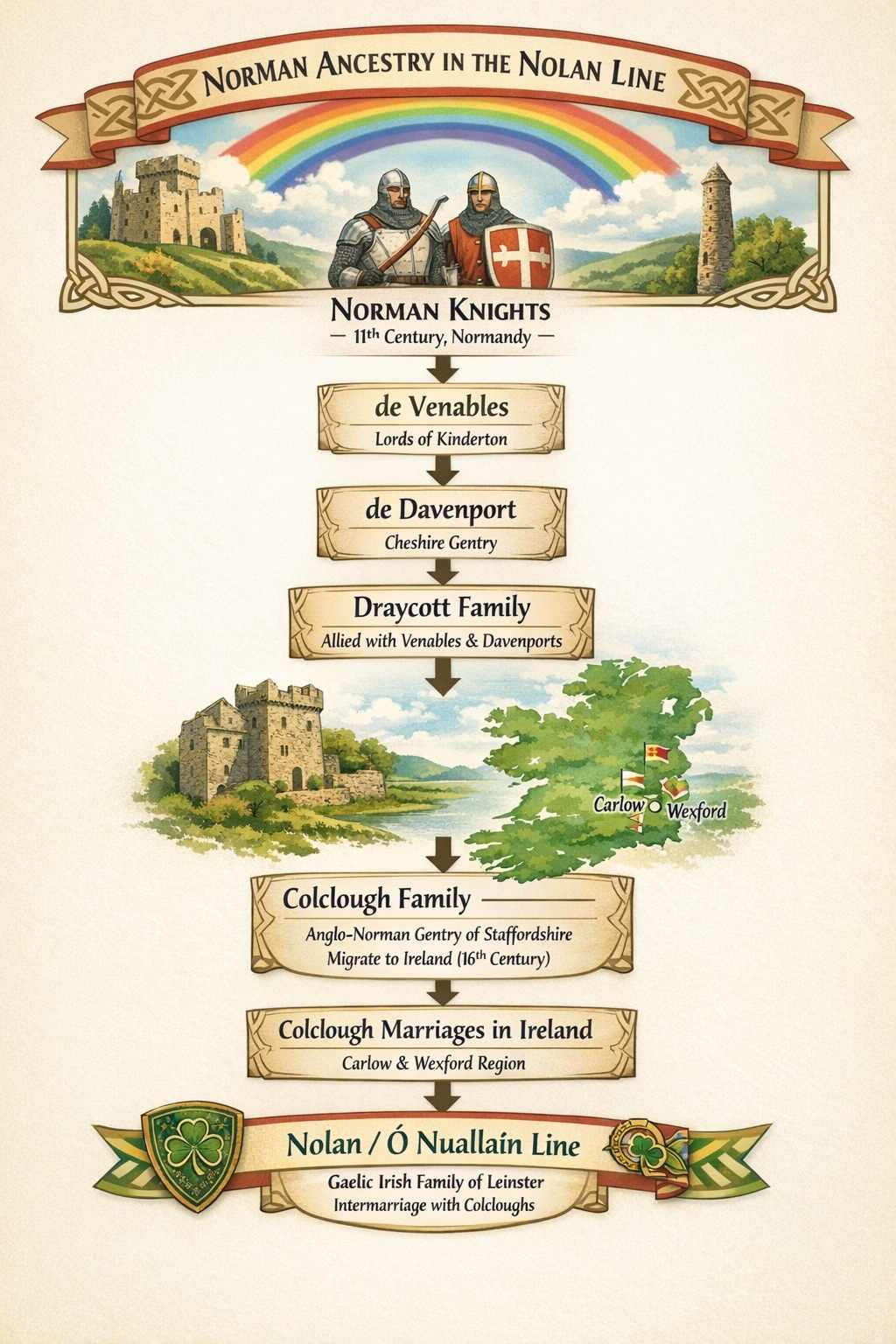
Norman Knights (11th–12th c.)→Venables / Davenport / Draycott→Colclough (Norman-English gentry)→Ireland (16th c.)→Marriage into Nolan families
This means:
not through the original Gaelic Nolan founders.
There are three major ancestral layers converging:
|
Layer |
Origin |
How It Enters the Nolan Tree |
|
Gaelic Irish |
Ó Nualláin (ancient Leinster) |
Direct paternal Nolan line |
|
Norman-English |
Venables, Davenport, Draycott, Colclough |
Through intermarriage in Ireland |
|
Anglo-Saxon / Welsh |
Marcher families |
Through the same English lines |
This is exactly the kind of blended ancestry typical of Irish families who intermarried with English settlers in the 1500s–1700s.
🌳 Clean Lineage Chart: Norman Families → Nolan Line
┌──────────────────────────────┐
│ Norman Knights (11th c.) │
│ Families from Normandy, FR │
└──────────────┬───────────────┘
│
▼
de Venables (Norman)
Lords of Kinderton
│
▼
de Davenport (Norman-era)
Cheshire gentry
│
▼
Draycott Family
(Intermarried with
Davenport & Venables)
│
▼
Colclough / de Colclough
Anglo-Norman gentry of Staffordshire
Migrate to Ireland (16th century)
│
▼
Colclough marriages in Ireland
(Carlow / Wexford region)
│
▼
Nolan / Ó Nualláin Line
Gaelic Irish family of Leinster
Intermarriage with Colcloughs
│
▼
Modern Nolan Descendants
• The Norman ancestry enters at the top through Venables, a documented Norman family from Normandy.
• It flows through Davenport and Draycott, two medieval English families with strong Norman-era roots.
• The Colcloughs are the key bridge — an Anglo‑Norman family who settled in Ireland.
• Once in Ireland, they intermarried with Gaelic families, including the Nolans.
• This creates a blended lineage: Gaelic Irish + Anglo‑Norman + earlier English Norman lines.
Origins
of the Nolan Name (Ó Nualláin)
All major surname authorities agree
that Nolan comes from the Gaelic name Ó Nualláin,
rooted in County Carlow, in the province of Leinster,
Ireland.
Ancient
Tribe and Gaelic Lineage
Historically, the O’Nolans were part of the Loígis
tribe, descendants of the Cruthin, some of
the earliest Celts in Ireland (between 800–500 BC).
·
The
Nolan
family is of purely Irish origin, tied deeply to ancient Gaelic clans in
County Carlow.
Origins of the Jennings Family in Ireland
The Irish Jennings families were
originally Norman.
More precisely, they descend from the Norman / Cambro‑Norman de Burgh
(Burke) family, one of the most powerful Anglo‑Norman dynasties in
medieval Ireland. Their Irish surname Mac Sheoinín
(“son of little John”) was later anglicized to Jennings.
Detailed Breakdown
1.
Jennings as an Irish Name: Mac Sheoinín
Multiple historical sources agree
that the Irish Jennings surname is an anglicization of:
Mac Sheoinín
/ Mac Jonin — “son of little John (Seoinín)”
This refers to descendants of John (Seoinín) Burke,
a member of the de Burgh/Burke dynasty.
[houseofnames.com],
[nolan-crombie.com]
These families settled chiefly in:
2.
Their Connection to the Burkes (de Burghs): A Norman Lineage
The de Burgh / Burke family were Cambro‑Norman
knights who arrived in Ireland during the 12th‑century Norman
invasion.
Key points:
Thus, the Irish Jennings families
are directly descended from the Norman de Burgh lineage, not native Gaelic
clans.
3.
Later History in Mayo and Galway
Sources note that the Jennings
families:
4.
English Jennings vs. Irish Jennings
It’s important to note that Jennings
also exists as an English surname, unrelated to the Irish Mac Sheoinín line.
The English version is a patronymic meaning “son of little John” from
Middle English/Old French roots.
[selectsurnames.com]
Thus, not all Jennings families
are Norman-Irish, but the ones native to Mayo and Galway clearly are.
Conclusion
Yes — the Jennings families of
Ireland were originally Norman.
They descend from John (Seoinín) Burke, part
of the powerful Cambro‑Norman de Burgh/Burke dynasty that settled
in Connacht after the Norman invasion of the 12th century. Their Gaelic surname
Mac Sheoinín evolved into the modern Irish
Jennings.
Here’s the clearest, evidence‑based picture of the Bynell surname and its historical roots, based strictly on what survives in modern genealogical databases.
The surname Bynell is extremely rare. All major surname databases agree that:
It appears primarily in Britain and Ireland as part of the broader pool of English surnames. Ancestry
The earliest traceable clusters appear in England, with later migrations to the United States, Canada, and Sweden (through isolated 19th‑century marriages). Geneanet
The surname is so uncommon that Geneanet ranks it 210,948th in frequency—meaning only a handful of individuals appear in historical records. Geneanet
No authoritative etymology exists for Bynell, but based on English surname patterns and the similar names listed alongside it (Bell, Knell, Brunell, Bunnell), it likely originated as:
A locational surname (from a place or geographic feature),
Or a patronymic/occupational variant that
later stabilized into the spelling Bynell.
(Ancestry
notes that most surnames of this type in their database trace back
to Britain and Ireland.) Ancestry
Because the name is so rare, it may represent:
A branch of a more common surname that diverged through spelling drift,
Or a localized family group that never expanded widely.
The largest concentration of Bynell families appears in England in 1891. Ancestry
By 1880, small Bynell households appear in Wisconsin, representing the earliest known U.S. presence. Ancestry
Later records show individuals in Minnesota, Texas, Kentucky, and British Columbia. SortedByName.com
A single 19th‑century Swedish marriage (August Bynell to Maria Petersdotter) appears in the archives, suggesting either:
A Scandinavian branch that adopted the surname, or
A British emigrant line entering Sweden.
Geneanet
Because the surname is rare, the earliest identifiable Bynells in surviving records are from the 19th century, including:
David Bynell (1879–1963) – Minnesota, USA. AncientFaces
Richard Bynell – Married in England between 1825–1875. Geneanet
August Bynell – Married in Sweden between 1825–1875. Geneanet
No medieval or early‑modern Bynell lines are documented in any major genealogical database.
AncientFaces, which often preserves user‑submitted historical notes, confirms that no early history, origin story, or medieval lineage is currently known for the surname. AncientFaces
This means:
The name likely emerged in the 1700s–1800s,
Or earlier records used different spellings, making the line difficult to trace.
The Bynell surname is a rare English-origin name with:
Roots in Britain,
Small 19th‑century expansions into North America and Scandinavia,
No known medieval pedigree,
And a likely connection to more common English surnames through spelling evolution.
Here’s a clear, evidence‑based breakdown of the origins of the surname Theisen, drawing from multiple authoritative sources.
Theisen is primarily a German patronymic surname derived from the given name Theis, a short form of Matthias (Matthew). This makes it a name meaning “son of Theis/Matthias,” rooted in Christian naming traditions of medieval Europe. HouseofNames Geneanet
Theis ? diminutive of Matthias, from the apostle Matthew.
Theisen = “son of Theis.”
This form was widespread in medieval Germany, Denmark, and
Norway.
HouseofNames
Geneanet
Some sources note:
Theis may also have been associated with an Old High
German term referring to a thief or detainee,
though this is considered a minority interpretation and not widely
accepted in mainstream surname etymology.
igenea.com
Earliest records place the surname in Westphalia and the Rhineland.
Strong concentrations historically in:
Blankenrath
Cochem
Düsseldorf
Mittelstrimmig
Schweich
Zeltingen‑Rachtig
Geneanet
Belgium (especially Hondelange)
Denmark
Norway
Luxembourg
Geneanet
Documented immigrants include:
William Theisen, Pennsylvania (1758)
Johannes Theisen, Philadelphia (1764)
Maria Katharina Theisen, 1852
HouseofNames
nolan-crombie.com
Common spelling variants include:
Theis
Theissen
Thein
Theitz
Theisz
Theisman
HouseofNames
These reflect regional dialects and shifting orthography over centuries.
Modern DNA‑based surname studies show that people with the surname Theisen most commonly have:
French & German ancestry (˜45%)
British & Irish (˜28%)
Scandinavian (˜8%)
discover.23andme.com
This aligns with the surname’s Germanic and Northern European distribution.
Theisen is a German patronymic surname meaning “son of Theis/Matthias,” originating in medieval Germany—especially Westphalia and the Rhineland—and later spreading into Belgium, Scandinavia, and North America. Its strongest historical roots are firmly German, with deep ties to Christian naming traditions.